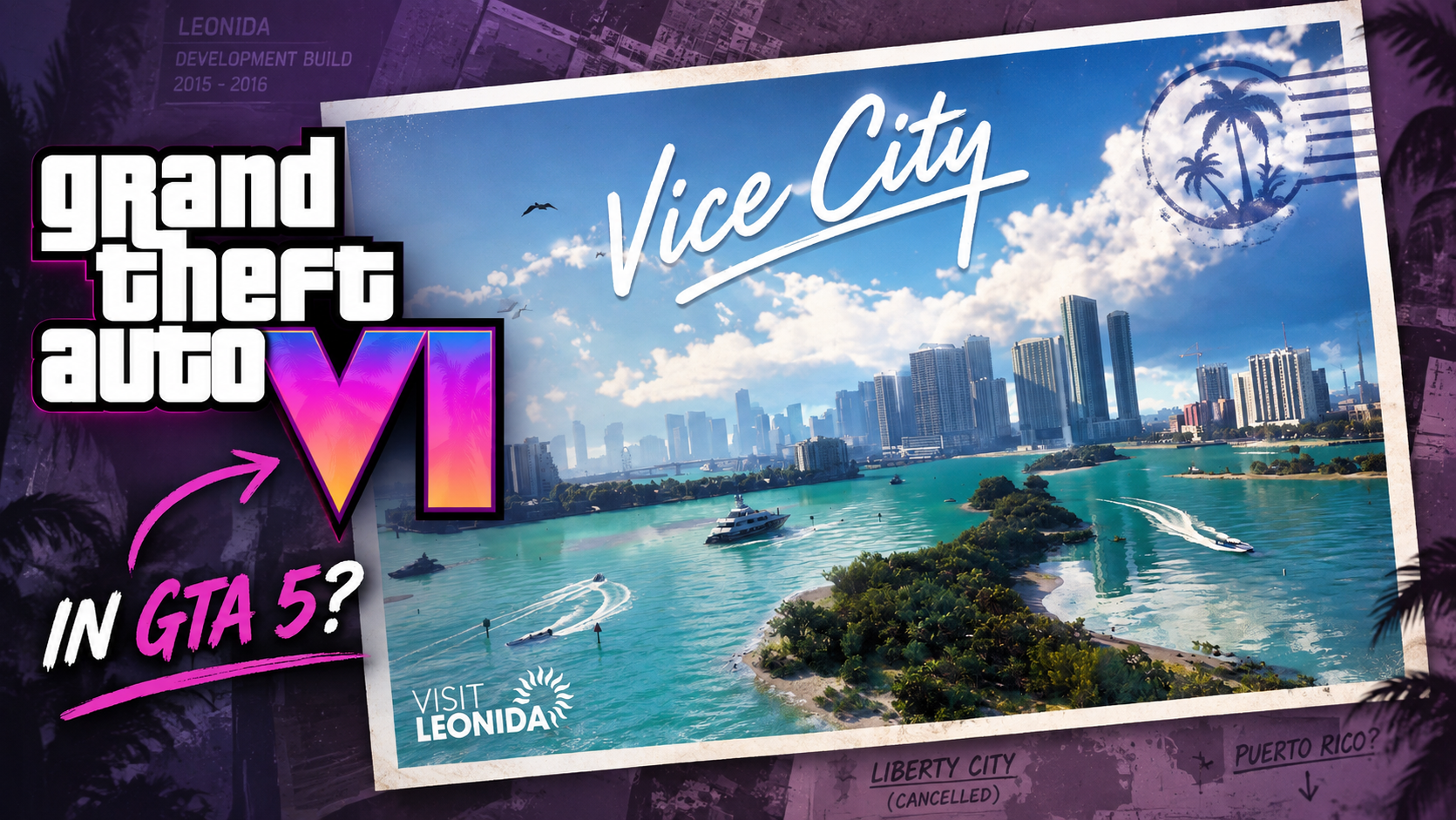

GTA 6 may be trying to do something console games rarely achieve all at once: look spectacular, simulate a dense living world, and hold that together inside a giant open map on a base PlayStation 5.
That is the real takeaway from Digital Foundry's breakdown of Rockstar's Extended Look footage.
The headline is not just that GTA 6 looks good. It is that the game appears to be stacking several expensive technical goals on top of each other at the same time. Dense crowds, heavy traffic, advanced lighting, layered reflections, detailed interiors, complex character animation, and a world that still needs to stream smoothly while the player moves through it at speed.
That combination is what makes the footage feel so unusual.
The visual leap is bigger than texture quality
A lot of surface-level discussion around GTA 6 still falls back on a familiar complaint: that it looks like GTA V with stronger lighting and cleaner assets.
That reading is far too narrow.
The real generational jump does not seem to be about one sharper wall texture or a more detailed face model. It is about how much Rockstar is trying to render and simulate at the same time. Vice City at night is full of signage, headlights, street lighting, wet surfaces, glass, and water all reacting to the scene around them. That would already be demanding in a tightly controlled level.
GTA 6 is trying to sustain that look inside an open world.
That matters because Rockstar is not building a graphical showcase where the camera follows a safe path through a small corridor. The player is expected to drive fast, change direction instantly, trigger NPC behavior, enter busy districts, and keep moving through a world that remains visually rich from block to block.
Characters and crowds may be where the hardware load really shows
The environmental rendering is only part of the picture. The characters may be just as important.
Jason and Lucia clearly show a major upgrade in facial detail, skin response, hair rendering, clothing material, and animation quality. But what stands out even more is that Rockstar is not reserving all of that fidelity for isolated hero shots. Beaches look crowded. Roads look active. Interiors appear populated. Background NPCs no longer feel like filler pasted into the frame to suggest life.
That is where the scale of the challenge becomes more obvious.
Rendering a beautiful protagonist is one thing. Filling a modern open world with large numbers of believable people, vehicles, lights, reflections, and ongoing systems is much more expensive. GTA 6 looks like it wants all of those layers to coexist instead of asking the player to focus on only one at a time.
Why 30 FPS may be the compromise Rockstar accepts
One of the most important points from the technical analysis is the strong suggestion that the gameplay footage in the Extended Look is running at 30 FPS on a base PS5.
For some players that will immediately sound underwhelming. In 2026, a lot of console players are used to performance modes targeting 60 FPS. Once you adapt to that, 30 can feel like a step backward.
But GTA 6 is not facing a normal rendering problem.
Lowering resolution can reduce GPU pressure. It does not automatically solve a CPU bottleneck. And a game like GTA 6 is not only pushing pixels. It also has to continuously handle traffic logic, pedestrian behavior, physics, animation, police systems, streaming, and the wider world simulation that gives Rockstar games their sense of life.
If the CPU is doing a huge share of the work, then dropping from 4K to a lower resolution does not magically create a stable 60 FPS mode. That is why a polished, stable 30 FPS target remains plausible, especially for a studio that has historically prioritized density and world complexity over frame rate on consoles.
The PS5 Pro may help, but not in the way some people expect
That logic also explains why the PS5 Pro should be treated carefully in this conversation.
A stronger console can absolutely improve the experience. Better image quality, stronger ray tracing, cleaner reconstruction, or more stable performance all sound realistic. But there is a difference between improving presentation and doubling frame rate.
If GTA 6 is heavily constrained by simulation and CPU-side workload, then even a more powerful machine may not simply unlock a flawless 60 FPS mode. Rockstar could still choose to spend extra headroom on visual quality, denser effects, or more stable frame pacing instead.
That would fit the company's history.
Rockstar has usually chosen to make its worlds feel heavier, richer, and more convincing rather than chasing the highest console frame rate possible. Everything about GTA 6 suggests that philosophy is still intact, only pushed much further.
The Extended Look may not be the last major presentation
There is another interesting angle here that goes beyond pure performance analysis.
Rockstar called this presentation an Extended Look, not a final gameplay deep dive or a one-off trailer. That wording leaves room for more. The Netflix-style event framing also made the reveal feel closer to a scheduled entertainment broadcast than a simple upload.
That is why a second major presentation still feels possible.
Rockstar used a similar multi-step approach before Red Dead Redemption 2, releasing more than one official gameplay showcase before launch. GTA 6 would justify the same treatment even more easily. There is still plenty Rockstar has not shown properly: wanted systems, free exploration, interiors, economy, customization, and the minute-to-minute rhythm of simply moving through Leonida.
If this first Extended Look was designed to establish technical confidence and visual spectacle, a follow-up could focus much more directly on systems and player freedom.
GTA 6 looks expensive in the right way
The most convincing argument in favor of GTA 6's visuals is not that every frame looks photo-realistic in isolation.
It is that the game looks expensive in the right way.
Rockstar appears to be spending hardware budget on the things players will actually feel while playing: crowd density, world simulation, environmental complexity, lighting interaction, traffic, animation quality, and the sense that Vice City remains alive even when the camera is not carefully staged for a trailer.
That is also why a stable 30 FPS may be easier to accept than people think right now. If the final game ships with strong frame pacing and consistent performance, most players will adapt quickly. The bigger win will be whether Leonida feels truly alive the moment you take control.
And based on what the Extended Look suggests so far, Rockstar may be pushing the base PS5 as far as it can to make sure that happens.
Watch the full video
If you want the original video version of this breakdown, watch it here: