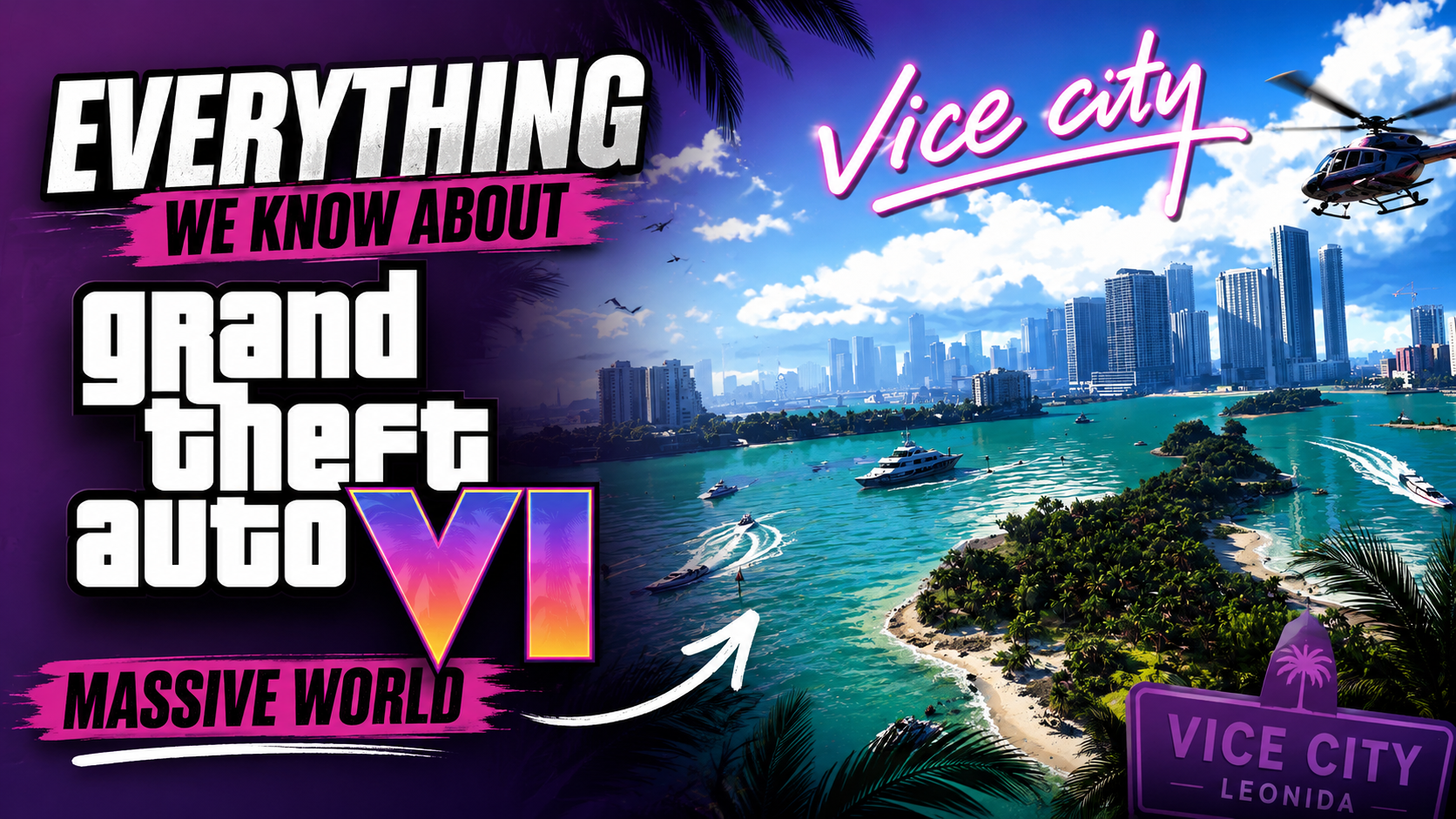
Everyone keeps asking the same question about GTA 6.
How big is the map?
It makes sense. Ever since Rockstar properly revealed Leonida, the community has been trying to work out just how much larger this world might be than GTA V or Red Dead Redemption 2.
But I think that question only gets you part of the way there.
Because if Rockstar has proven anything over the last twenty years, it is that raw size alone does not make an open world memorable.
The current estimates are already massive
Based on the community's long-running GTA 6 Mapping Project, Leonida is currently believed to be somewhere around two to two-and-a-half times the size of GTA V's map.
If that estimate is even roughly correct, GTA 6 would comfortably become Rockstar's biggest open world to date. It would also move past Red Dead Redemption 2, which already felt huge because of how much atmosphere and regional contrast it packed into its space.
That part is easy to understand.
GTA V already felt enormous when it launched. Los Santos, Blaine County, Mount Chiliad, desert roads, forests and coastline gave the game a scale that felt massive at the time.
Then Red Dead Redemption 2 showed something more interesting. Its world did not just feel large because of distance. It felt large because every major stretch of land had its own mood, rhythm and identity.
That is what makes GTA 6's map so promising.
From everything Rockstar has shown so far, Leonida does not look like one oversized city with filler wrapped around it.
It looks like a full state with distinct regions that actually matter.
Leonida already looks built around contrast
This is not just Vice City repeated over and over.
You have the dense urban sprawl of Vice City itself. Then you have the swamps of Grassrivers, the tropical pull of the Leonida Keys, industrial zones like Port Gellhorn, and mountainous terrain such as Mount Kalaga.
Even in short trailer clips and isolated screenshots, those places already feel separate from one another.
That matters more than people sometimes realize.
A giant map becomes forgettable very quickly if every region blends into the next. If the roads, towns and landscapes all feel interchangeable, then the size starts to work against the experience instead of improving it.
Rockstar usually understands that better than most studios.
The strongest open worlds are not just large. They are legible. You remember where you were, what kind of place it was, and what sort of activity or mood belonged there.
Leonida looks like it could be built exactly that way.
The more important question is what fills the world
Even if GTA 6 ended up being only twice the size of GTA V, that still would not be the biggest leap.
The bigger leap would be what Rockstar fills that land with.
That has been one of the biggest problems in open-world design over the last decade. Plenty of games kept making maps larger without giving players many new reasons to care about the space between missions.
You would spend minutes crossing forests, highways or countryside that looked impressive from a distance but did not really offer much once you were inside it.
GTA 6 does not seem to be chasing that approach.
Everything shown so far points more toward density than empty scale.
Trailer 2 especially feels busy in a way that suggests Rockstar wants the world to feel active at all times. Beaches are crowded. Streets are packed with traffic. Bars, clubs and restaurants look full of people. Even the swamps appear alive with wildlife instead of existing as dead space between landmarks.
That is a very different promise from simply saying the map is bigger.
It suggests a world that keeps moving whether the player is watching it or not.
Variety of activity could make the map feel even larger
There is another reason Leonida may feel bigger than the raw dimensions suggest.
The number of activities and systems Rockstar seems to be layering into it already looks unusually broad.
We have seen hints of gyms, fishing, hunting, diving, basketball courts, nightlife, underground fighting, street racing, jet skis, airboats and a surprising number of businesses that look at least potentially enterable.
On their own, each of those details might sound minor.
Together, they change how a world feels.
A map feels small when it only exists as a route between objectives. A map feels huge when different parts of it support different kinds of play.
If the Keys are good for boating and diving, if Vice City is dense with nightlife and traffic chaos, if the swamps support wildlife encounters and strange random events, and if industrial zones create a completely different atmosphere again, then Leonida stops feeling like one space.
It starts feeling like multiple worlds stitched into one state.
That is usually what makes players keep exploring long after the story stops pushing them forward.
Random world activity may be the real force multiplier
I also think the real scale of GTA 6 will come from what happens between planned activities.
That is where Rockstar has often been strongest.
Red Dead Redemption 2 constantly surprised people with random encounters, small discoveries and unscripted moments that made the world feel like it had a life of its own. Players were still finding new interactions years after release.
If GTA 6 expands that idea inside a modern state packed with social media culture, nightlife, road traffic, wildlife and dense NPC behavior, the effect could be much bigger.
Imagine driving across Leonida and stumbling into a street takeover that was not part of any mission. Or passing an influencer filming content on the beach, a biker convoy moving through the countryside, a police chase involving NPCs instead of the player, or an alligator wandering somewhere it absolutely should not be.
Those are the sorts of moments that make people stop thinking in square miles.
They just keep exploring, because the world keeps giving them reasons to.
That is how a map starts to feel bigger than its physical dimensions.
The GTA 6 Mapping Project says a lot about the anticipation itself
That is also why the GTA 6 Mapping Project has become such a big deal.
If you have not followed it, the project is a long-running fan effort to reconstruct Leonida using only Rockstar's official material: trailers, screenshots, artwork and every visible clue people can extract from them.
Fans compare skylines, road layouts, building positions, bridges, coastlines and even shadows to work out how different scenes connect. It is an absurd amount of work, but it is not just random wishful thinking.
The same kind of community work got surprisingly close to GTA V's final map before that game even launched.
That track record is why so many people take this effort seriously now.
Nobody outside Rockstar knows exactly how accurate the current version is. There are almost certainly hidden areas and withheld surprises. Rockstar has always been careful about that.
But even if the fan reconstruction ends up only being eighty or ninety percent correct, it is still an impressive achievement.
And honestly, it is also one of the clearest signs of how huge the anticipation around GTA 6 has become.
People are not just waiting for Leonida anymore.
They are trying to solve it in advance.
Why the map debate may be asking the wrong question
That is why I keep coming back to the same point.
I do care about how large GTA 6 is. If Rockstar really has built a map around two to two-and-a-half times the size of GTA V, that is a major step up.
But I care more about whether Leonida feels alive, distinct and full of reasons to wander.
Because that is what players remember.
Not the total number of square kilometers.
Not the marketing bullet point.
The real test is whether every region feels like it has its own personality, its own activity and its own surprises waiting between the major story beats.
If Rockstar gets that part right, GTA 6 will not just have the biggest map it has ever made.
It will have a world that feels larger than the raw numbers can really explain.
Watch the full video
If you want the original video version of this breakdown, watch it here: